Grossmünster, Where Swiss Thrift Began
Zurich's twin-towered landmark is where Huldrych Zwingli launched the Swiss Reformation in 1519. The plainness it preached fed a culture of thrift long linked to the character of the city's banks.
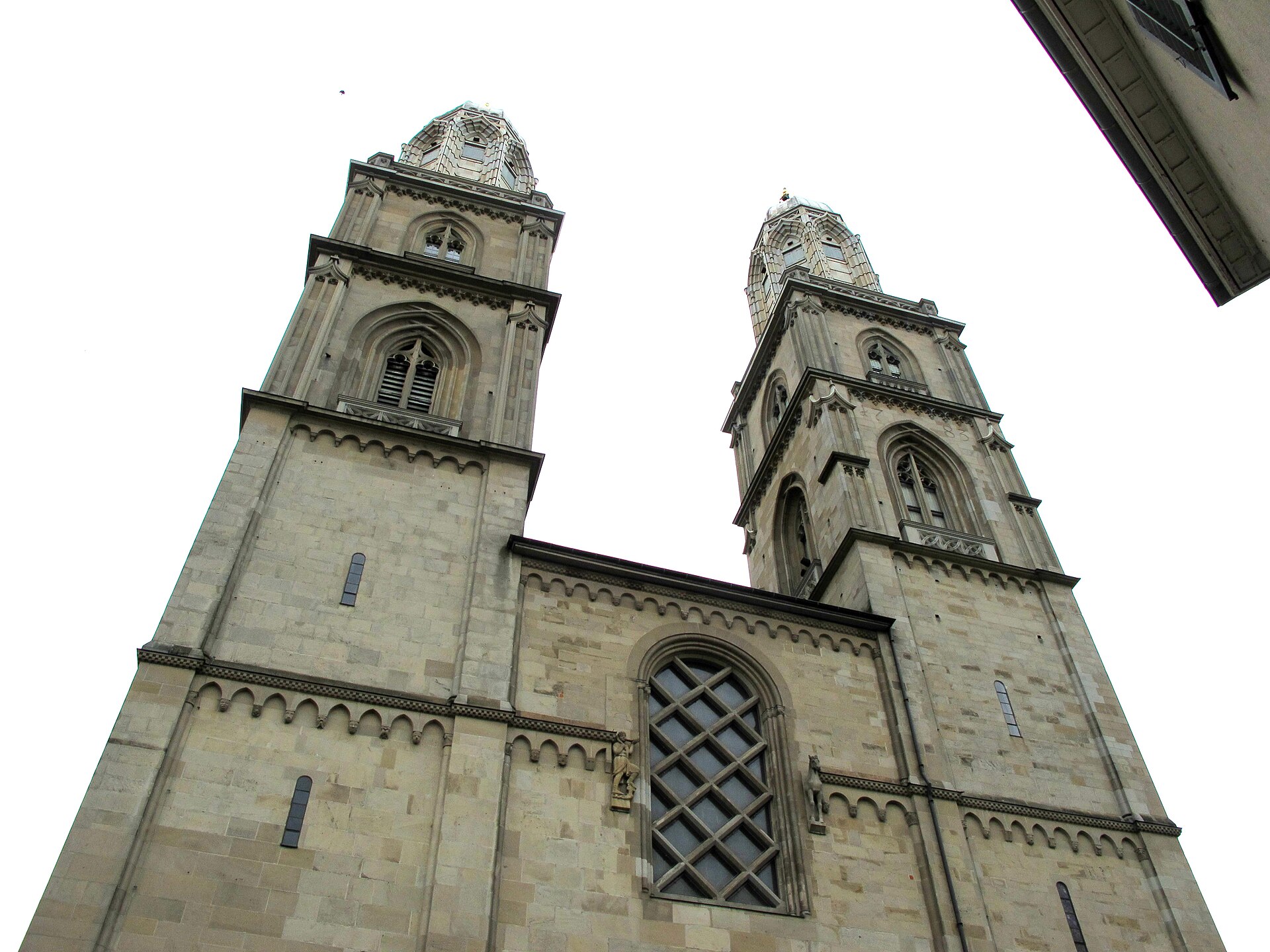
The Grossmünster, with its two matching towers, is the postcard image of Zurich. It is also the place where a single preacher changed the character of the city, and arguably helped shape the way it handles money to this day.
The church that stripped itself bare
In 1519 a priest named Huldrych Zwingli took up his post at the Grossmünster and began preaching reform. Out of his sermons grew the Swiss Reformation. Zwingli and his followers believed worship should be plain, so they stripped the church of its images, its colour and its ornament. Walk inside today and the interior is still startlingly bare, all grey stone and clear glass. The sobriety you see is the Reformation, frozen in place.
The building itself is older than that. Its towers went up in the late 1400s, and the pointed tops that give the city its skyline were added in the 1780s, after a fire destroyed the earlier wooden spires. You can still climb the south tower, a few steps short of two hundred, for one of the best views in the old town.
Why austerity became an asset
Zwingli’s reforms were about faith, not finance. But the link between the two is a famous and long-argued one. The sociologist Max Weber tied the Protestant ethic of thrift, discipline and hard work to the rise of modern capitalism, and Zurich sits squarely in that Reformed tradition. Whether or not you accept the full theory, the values the Reformation pressed into the city, plainness, discipline and a suspicion of show, are a good fit for the business of looking after other people’s money. It is not a stretch to read the careful, understated Zurich banker as an heir, in spirit, to the congregation that whitewashed these walls.
That is the quiet reading we take from the Grossmünster, and the hopeful one. The same severity that can look cold from the outside became, over centuries, a kind of reliability the world learned to trust. A city took an austere idea about how to live and turned it into a reputation for keeping promises. This plain grey church, with its two towers over the river, has a fair claim to standing near the start of that story.
Sources
- Grossmünster, Wikipedia
- Huldrych Zwingli, Wikipedia
- The Reformation in Zurich, Zentralbibliothek Zürich
- The Protestant Ethic and the Spirit of Capitalism (Max Weber), Wikipedia